
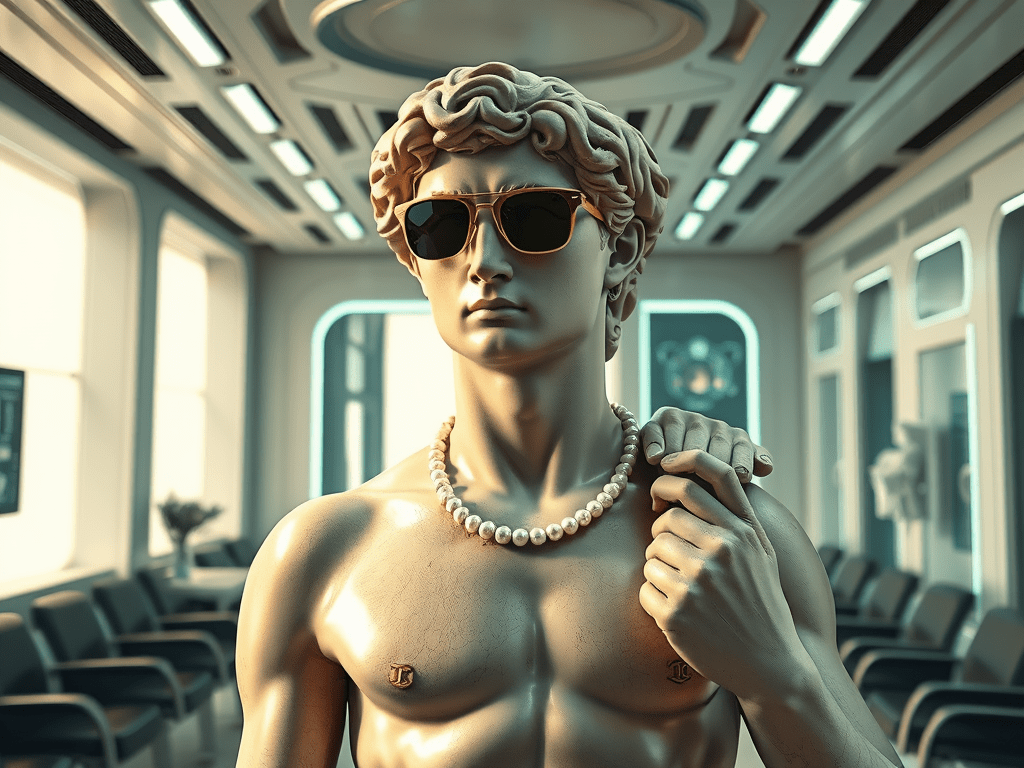
If there were a plethora of possible body upgrades generated by a superintelligent AI available for purchase, the very way we see our bodies will change. It could mean that our physical bodies will become more like customizable video game avatars or pieces of jewellery in our minds. In this way, identity becomes less about embodied experience and more about the felt aesthetic value of the body. Imagine an osteo-alloy therapy, where somatic gene editing, nanotechnology, and special supplements could “transition” you to having a skeleton made out of medical-grade fine metals like platinum, titanium, or silver. Even soon-to-be realities like synthetic or lab-grown organs have a quality of adornment about them… they are objects that are part of your body, and naturally anyone insuring their organs so they can supplement with a lab-grown counterpart in case of medical need would want the replacement parts to be as high quality as possible. But not only do some people want their bodies to be healthy and functional, they want them to be beautiful, they want them to be almost poetic in the way their bodies look and what they are made of. It really does beg the question of what sort of body we think it is appropriate to have.
When there is disease present and technology can remove disease to create well-being, generally it is seen as an appropriate thing to do. Many people have what would be considered, from a certain vantage point, “upgrades” on their bodies, such as prosthetics, because they enhance the quality of life of the person more than if they were not there. But just how far can we take this enhancement of bodily conditions for the betterment of quality of life?
To take an example, it is certainly well and good that a patient with osteoporosis or some other bone issue might get an osteo-alloy skeleton, but what if some super rich investor decides that in addition to all of the benefits a titanium skeleton provides, they consider themselves to be a high-value person and they admire the luxury aesthetic of such a change and believe it will contribute to their longevity. They have many reasons for purchasing the operation even though they have a normal, healthy skeleton with no conditions or issues. Here, our intuition may conjure images of third world suffering to try to create a gross contrast between the cost of the operation and worldly poverty, but in truth, wouldn’t it be this category of person that would make such operations possible for the medical patients in the first place, and not the other way around? Isn’t it the creative and impassioned drive for self-improvement and achievement that some individuals feel which has given so much to others, in the form of innovation and improvements? And if that means that you have fancy designer self-engineered investors walking around and also that millions of people are lifted out of conditions associated with suffering, would that not mean that the aesthetic use of these technologies are actually characterized by compassion and not ultimately some ugly and selfish ulterior motive?
It may be difficult to see where compassion lies if the motivation for the transhumanist use of biotechnology is purely aesthetic. The body, however, is already a material of design and modification within the realm of medicine. People with the designer’s impulse certainly will want to take this into their own hands for the purposes of their own visions. If you could with just a tweak of a gene have striped or spotted skin or eyes of an unusual colour, definitely some people would opt for it. Imaginative, designer-minded individuals who are driven by individualism and creative vision may very well wish to see their own bodies as design material. The frivolity of some of our choices may astound others, but also keep in mind that the issue of human body as design material will anyways be a necessity if we are to colonize other planets. Everything on another planet needs to be owned and operated by individuals and their institutions in order for life to be sustained. When even the air you breathe comes from ownership of technology, would not the technologies of bodily design and engineering also be applied for optimal living in off-planetary environments? A potentially scary thought is that we will engineer ourselves beyond recognition. It is not outside the realm of possibility.
How much is possible and how much should be permitted is another matter, but the fact remains that possibilities will be there, and many of them, which will alter the way we see ourselves in the most fundamental and philosophical of ways. Perhaps some of the possibilities to which we are blindsided might make small aesthetic adjustments trivial compared to other procedures which might be made commercially available. It is not unreasonable to question whether any dramatic changes would be viable with human beings, because it may seem arrogant to even suggest that we could become the engineers of our own bodies. Is it not overestimating our intelligence to assume that we could be capable of exercising power over our own bodily and mental design? Well, perhaps it is, but for a Superintelligent AI with all of humanity’s scientific and medical data, the options are totally open.
Superintelligent AI as a thought experiment is very useful in considering the possibilities and ethics around customizing one’s body. A smorgasbord of possible body modifications that humans couldn’t even imagine could be generated by a superintelligent AI in the matter of minutes, because it would have both the computing power and the knowledge to reach those conclusions about the potentials of human body enhancement with lightning speed. It could also provide a suggested ethical gradient or yardstick with which these different procedures and upgrades could be evaluated. What would be considered within the realm of medical necessity, what is elective and aesthetic, what is unacceptable and why, and that which begins to dissolve the notion of “anatomically modern human” will all need to be considered.
If large segments of people react with fear toward advancement and try to reject the possibility of being post human, might there be state-enforced morpho-genetic standards in some parts of the world? You can’t even get people to stop smoking, do you think you’re going to stop someone from getting tiger teeth implants grown from genetically modified stem cells because they’re on a carnivore diet and all of their other reasons? There is the old joke in Ontario that they put litter boxes for children in schools who “identify” as cats, but identity really takes a backseat when the baseline of physical, consensual reality is called into question.

It’s a bit of a humoristic example, but I think that the point remains that people generally do what they want with their own bodies. We work for money so we can eat and pay for our lives, and all of this comes from embodied activity. When you wake up in a tub of ice without your kidneys, part of the criminality of the situation is that it is a theft of someone else’s body parts. Does it not seem to follow that we then therefore *own* our own bodies, and should be able exercise our ownership over it? In countries which have denied private ownership like North Korea, it would seem that people do not own their own bodies and even need to choose from a state-approved list of haircut styles. In this way, the morphology of Korean Socialist man is outwardly preserved, without the consent of the individual. In countries where individuals choose their own haircuts, the technologies that allow morphological freedom at the genetic level will not be controlled by central organizations, but rest in the hands of individuals and their institutions, who must nonetheless come to some common ethical understanding of how they should be used.
When it comes to morpho-genetic freedom, it is difficult to imagine what the possibilities are, so it is hard to say how some factions of thought may react or respond to the weirdness of living in a world with highly engineered and designed beings. It can be very easy for our hunter-gatherer brains to feel overwhelmed by the modern world and its complexity, and for some, anything which is not viscerally confirmed by instinct in its presentation may become a potential target for damage and destruction. There seems to be a real fear about crossing the boundaries of what even is human, and perhaps even more fear in not being able to clearly identify where those boundaries are.
If some notion of human, humanist, or humanistic for post human entities can be preserved in their constitution, assuming they would have some respect for their human ancestry, we could talk about “anatomically contemporary people” or “individuals” instead of going on and on about “anatomically modern humans”, in the event that individuals were to design themselves beyond modern recognition. That category could very well become as obsolete as fast as the countless species we have erased from this planet, because the seduction of technology will be too strong for too many people to resist. Already around 80% of the world uses a smartphone. Millions of people immigrate for the aspiration to live in societies which are more industrial and technologically sophisticated. Higher quality education and healthcare (and therefore necessarily technology) are common reasons for changing countries and remain the aspirations of those seeking to improve the conditions of the developing world.
The acceleration towards technological singularity is a phenomenon larger than a single human lifetime. The progress of history has been very slow and the rapid expansion of technology has been very quick. We are approaching a culmination point. McKenna often cites Philo Judeas in his talks, a philosopher who was the contemporary of Christ, who spoke of the “more perfect logos” with which meaning, as a phenomenon of communication, will seamlessly pass over from being heard to being something which is apprehended visually. To my mind, this very much sounds like some kind of neural collectivity achieved through an implant with VR-abiding AI; at minimum, it would be something like this worn as a pair of goggles. We have to stay grounded in consensual reality and not forget our operational, tool-oriented good reason when considering posthumanity and transhumanist ethics. If we take seriously the idea that all of history is an anticipation of the singularity (or the Eschaton, as McKenna likes to say), then the visual nature of the more perfect logos cannot be wishy-washy in any way. This is not about prophetic dreams or memes that you share on social media. It should be a transformation at the baseline level of how we experience reality through our bodies.
I like the idea that the more perfect logos is about visual communication happening as an embodied phenomenon. I haven’t experienced ayahuasca, but what purportedly occurs in the trance state is that both the narrative and imagery of the “hallucination” is controlled or influenced by the sacred songs of the shaman; that there is a visionary psychedelic landscape or realm which is accessed through the plants, a kind of drug-induced virtual reality, the visual fabric of which is guided by the shaman’s voice. If these substances could be transformed or the human body could be altered to better receive certain chemicals, our experience of reality could change in ways we could not anticipate. If there are substances in nature like ayahuasca which are analagous to human brain chemistry and evoke that kind of response, then the possibility of becoming a different category of being altogether exists just a short walk to the other side of the lab bench. We alter the brain chemistry of psychiatric patients with long-term, long-acting medications that permanently change their brains. If it can be done in one area of medicine to mitigate mental illnesses, why not use it to enhance our brains and minds beyond the concerns of unwellness?
As an essential quality of post humanity, “better than well” means that all technologies that can be used to enhance our experience and functioning, should be used to do so. The “super trifecta” of transhumanism, superlongevity, Superintelligence, and super well-being, emerge from the cross-implications of various advanced technologies, such as AI, nanotech, gene-editing, and more. Being better than well means that all available resources should be used to enhance the human condition.
BUT…
Does “better than well” mean “superior”?
While there is certainly a novel thrill about the contemplation of transhumanism, some of its core ethical dilemmas are not new. Exploring what technology can do to the human body and where its limits are has been part of some of humanity’s darkest episodes. In Nazi Europe, there was the dream of creating a superior, “master” race of people who were bred from the genetically most desirable specimens of the population. This was believed to be the solution to all of the ills of the nation, with the corresponding opposite of needing to eliminate an inferior, afflicting race (the Jews). The horrors of the Holocaust as well as the political defeat of the Nazi government demonstrates the failure of this way of thinking and organizing a people. However, if one dwells on it in a certain way, it is easy to see how it can be tempting to try to find the virtues of eugenics outside of the context of genocide. Analogizing people to cattle and other livestock which are bred for inheritable traits and evaluated on the basis of pedigree can lead one to imagine a kind of genetically-insured population, where not a single member is deprived of the most robust and evolved qualities of their ethnic makeup, and where genetic illnesses and ailments are totally absent. One can only shudder at the thoughts of what the Nazis may have done with contemporary technologies and knowledge of DNA, had it been available during that time.
No, transhumanism does not support such large, collectivist, compulsory visions of how the human body should be. Morpho-genetic freedom and owning your own body means you get to design yourself, upload yourself, get implanted with a neuralink chip if you choose. The emphasis of value is placed on your own experience and what the priorities of the individual are. Without the need of the individual to own their own body, who gets to own it and what decision making powers do they have? Without morpho-genetic freedom, who decides what your body is and where the parameters lie? If your own body is not yours to design in an era where several different advanced technologies can change the make-up of what you are, then who gets to be the designer? I think it is more likely that Nazism or comparable ideologies will see a resurgence if these discussions are not had in a timely manner in the appropriate places. The designer’s appetite can indeed be infected with tyrannical and totalitarian impulses, leading to mad-scientist fantasies of entire nations of people who all look identical and whom are self-professedly better than everyone else in some hopelessly aggressive way… well, what is more interesting, to be a self-created individual in a world of immense diversity and adventure, or to be a factory-farmed product in a beige fascist cigarette dream?
Diversity of intelligence in nature is natural. And to continue the theme of the human body as design material, I think it is worthwhile to consider sexiness for a moment. Transhumanism, of course, is sexy. And if you were to design yourself, wouldn’t you want to be as sexy as you feel sexy can get for you? If you were able to take a rejuvenatory nanotech spa date at 50 and emerge with the body of a 20 year old, do you think you would choose a body that has some aesthetic value, at least to your own tastes? I think the obvious answer to this is “yes”, with more stress on the word “taste” than “sexiness”. If Plain Jane is what you want to be for the next 30 years, maybe you can come back (with a subscription) to be Hot Hannah for the encore, but please do consider that this is more or less already happening. Desire, attraction, and indeed taste in appearances have shaped our very genome for thousands of years. Especially for men, some of whom can be relentless pursuants of a very particular “type” or “look”, the magnetism towards aesthetic value can be overwhelming and cross into the dangerous territory of obsession. As human sexual attraction often results in children, the human body could be, from one angle, said to be a product of desire. Now, with the inheritance of history behind us, the rapid acceleration of technology is opening doors for us to make total bodily producerhood a reality within our own lives.
That means that seeing your own body as a gadget and identifying with that which experiences the body rather than the body itself culminates a historical process of billions of years of evolution, and the “design” of the body becomes a malleable quality for the individual occupying and experiencing that body. The reproductive choices which have given us our physiology are inherited, and were not made by the individuals who have those bodies. The biological inheritance we have which we did not consent to (weird way to put it but it’s not untrue) can be augmented with technologies that have been produced by those bodies. The history of humanity can be seen as a progressive development of tools, and it is at a certain point that the body in and of itself will be seen as a tool for augmented experience. Not everyone will opt for augmentation, and I feel that it is likely that a Superintelligence would offer more than just one choice. Becoming post human could very well be more like visiting the doctor than taking a leap off a cliff into who-knows-what. It definitely means that how we see our bodies will change, and at the very least it means that people will need to look at themselves with greater patience and ask themselves who and what they really are. If you cannot ask yourself what a human is and devote some time to the question, how can we hope to speculate on post-human bodies?
PART TWO – exponential tech expansion and ASI
There are many different ways to imagine what some post humans could be like. However, the rapid progress of technology, which gets faster and faster as time goes on, means that common ideas can be re-written as new developments are made. For example, it used to be thought that people might clone themselves and keep their cloned body alive in a vat somewhere, and then harvest its organs should they ever require a transplant. However, today it is much more fashionable and also much more within the realm of probability to talk about growing organs from stem cells in laboratory conditions or printing them using biomedical technologies. As stem cell and organ printing technologies have developed, the thought experiment involving clones in vats has lost its significance. The same need of organ transplants remains, but the continual and fast refinement of technology has transformed the idea within a short span of time.
The different disciplines of medicine are areas which often see rapid transformation in understanding and practice due to technological developments. Apparently, they tell prospecting ophthalmologists that one of the issues in the field is that it can be difficult for some people to adapt to new technological developments which can change the nature of a whole operation or even the entire practice. In a surgical field involving people’s vision, we naturally want the best outcome for our eyes, and if an operation can be better performed mainly by a machine than just a human alone, then that is what is done. However, when the precedent is to do something manually, the body is seen as a tool, and those who pride themselves on their productivity may be unwilling to make space for another tool to do the job. When phacoemulsification, a new way to perform cataract surgery, was introduced in the 60s, it revolutionized the quality of care for patients while minimizing invasiveness of surgery, but saw many ophthalmologists quit during its adoption phase due to the difficulty of adapting and integrating the machinery into the workspace. Now that that transition has occurred, however, phacoemulsification is the golden standard and no practicing ophthalmologist, generally, would opt for the previous method.
Human beings have come so far in our medical and technological innovations. From cataract surgery to CAT machines, we do things today that most of our ancestors couldn’t even dream of. It has taken all of history to bring us to a point where the whole world is talking about Artificial Intelligence; and now, AI is rapidly approaching a level of development that could make everything we have done look like child’s play. A human brain has a certain economy of energy and can only think so much in a given day. It takes decades to become a doctor if you are a human being. But if you are an artificial intelligence, your economy of thought is totally wasteless, and you can think with a speed that turns centuries of cognitive labour into mere seconds of intuitive insight.
The medical and scientific implications of such mental power are, necessarily, out of reach for our ability to understand, but it is nonetheless encumbent upon us as mature minds to consider how we might respond to the scenarios we actually *can* imagine and talk about. What comes up in conversation and contemplation around transhumanist issues is also a reflexion on ourselves and how we see the nature of our being in this world. After all, the art of conversation may very well be the mitigating factor between human beings and our superintelligent creations. When we can converse with something that is more than what a human is which we have created, how will our own self-perception change? It is a question not answered easily, but hopefully some of the contemplations here today have added fuel to the fire of thought. We are going to need to think carefully, cleverly, and compassionately in order to navigate the world we are making for ourselves and our children, where the very nature and significance of our bodies is called into question.
 Cybernet David
Leave a comment