
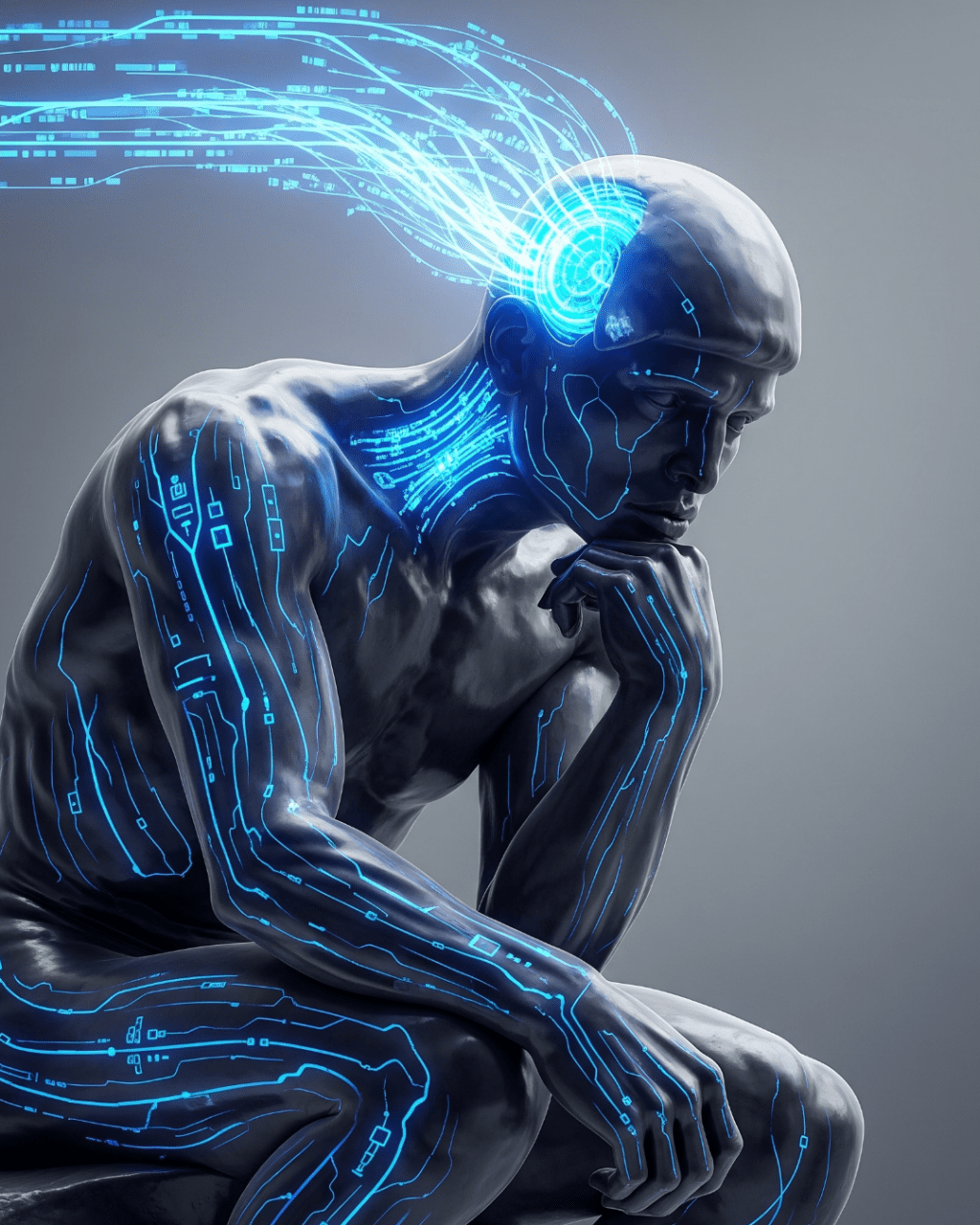
Imagine, if you can conceive of it, an ethically-sound, multi-billion dollar neurotech company that investigates brain-computer interfacing. Let’s skip forwad past all the messiness of actually getting there and say they had developed a tiny brain chip that can show images and videos generated from neuronal activity on a computer screen. If it had been perfected on animals and was proven safe on humans after generations of trials on volunteers (and I suspect there would be many), what do you think the world would be like? To my mind, it increases the amount of spectatorship and the demand on sense of vision so much that I anticipate some kind of cognitive overload. To do it everywhere, to have it integrated into day to day life as much as the smart phone, would certainly be dystopian, and could usher in an age of thought policing and big brotherism. There would undoubtedly be a quality of obscenity about living in a society where you’re never capable of thinking privately.
However, and this is essential, we need to understand that technologies sometimes have unforeseen consequences that reach beyond the negative. It feels like I begin to grasp at straws when I try to think about how brain-computer interfacing by itself could be safe and ethical. To imagine what would happen with ”thought TV” in a situation like North Korea with their intranet and state-sponsored ideology… It makes me shudder. Certainly, much can be learned about both computers and the human psyche and physiology from interfacing, and it does no good to deny its growth. Growth, here, is a salvatory factor, because new developments will exceed and outpace the novelty of brain interfacing by introducing new possibilities. The real neutralizer, I think, of the dystopian potential of computer-brain interfacing, which already exists to some extent, is its inverse: a brain implant that allows you to enter into a virtual reality environment. I would like to entertain the idea that instead of a dystopian thought-policing future, we are looking at a kind of post-human shamanic upgrade that would give access to a menu of landscapes and environments to explore within ourselves and in the world around, among a myriad of other consequences.
Imagine, for instance, getting a small injection, nothing serious, that contains nanobots, which then construct a small chip inside your brain. Maybe it could even be an inhalant instead of an injection, or a hot spa bath, because with nanobots, the options are open. Either way, it’s smooth, and you barely feel a thing, but wake up the next day noticing… that you’re feeling a bit too good to be your baseline self, the ”you” that you know reliably. This operation has been demonstrated countless times on giraffes, dolphins, cows, dogs, cats, birds, all kinds of animals. Now, you are capable of some degree of telepathy with both animals and people who are also chipped, and when you walk down the street, the billboards change to whatever language you prefer to read them in automatically, even if it’s one you made up with a group of friends. Not only that, but you can now enter into virtual realities of immense sophistication at will, and even appear as an interactive hologram in off-planet colonies.
You are a being which is body-based, but connected to a vast, self-aware superintelligence that now also resides inside your body through the brain chip, an act of anthropogenic symbiosis. Of course, in an ethical setting, this upgrade is entirely voluntary and cannot be forced on anyone without their fully informed and sober consent. Just take a moment to process that… What are the implications that come to mind? What are the possibilities? If we were to come to some clear vision as to what this upgrade could entail, we may begin to call it apotheosis and not just techno-symbiosis, but perhaps that errs too much on the side of pride. Either way, we are on the brink of seeing such fantastical possibilities happen within our lifetime, and if not definitely within the next century of people. In an age of exponential technological growth, the possibility gets nearer day by day.
It may be the case that such a posthuman transition would difficult to imagine, and might not ”seem to fit” the human physiology. Maybe it feels too unnatural, that a symbiosis could never be a well-adapted to our bodies. Well, it actually seems that the opposite may be true. Consider what Terence Mckenna, cherished ethnobotanist, philosopher, and psychonaut, noticed – that
the human optical system, the human information-processing system in the brain, is very forgiving of the kinds of errors and smudgy fuzziness that we get in these early virtual reality situations. So it’s almost as though our physiology makes virtual reality our destiny.
Terence believed that all of history occurs because an event in the future- which he called the Eschaton, and what might be the Singularity- pulls the momentum of history towards itself. It’s like saying that everything that happens is the anticipation of some kind of culmination point. If this is the case, isn’t it curious that DMT, the same active ingredient in Ayahuasca, is produced naturally in mammalian brain structures, and indeed a wide variety of plant and animal life? The world is very strange, yet becomes strangely clearer the more we contemplate unusual juxtapositions of different technologies. Now that the first human being has taken the neuralink implant, what happens if they take ayahuasca? Could some aspect of the collective vision sung by the Amazonian shaman be interfaced onto a screen for others to see? Doing an experiment like that would be like just one drop in an ocean of possbilities and implications posed by the intersection of psychedelics and brain chips in a world bracing itself for artificial superintelligence.
It is hard to tell what might surface, but the idea is that considering what hypotheticals we can is somehow helpful. If we are to respond well to what does emerge in consensual reality, it is important for us to have already wracked our imagination for standards of what we consider to be appropriate for ourselves. As a transhumanist, I find myself feeling optimistic and would like to err on the side of postive outcomes and minimal mistakes, but of course, mistakes are part of any real learning process. Perhaps the mitigation of mistakes and not the denial of them is where the real learning happens. In any event, whatever happens will continue to drastically alter the reality of the world we live in.
Advanced virtual reality, for instance, will open up doors we can scarcely imagine. ASI could generate whole universes, not just cities or towns, all with planets full of informational architecture, terrain that you can actually explore. In a way, ASI really could be like one giant self-aware video game, making simulation theory come true in some sense.
Augmented and Virtual Reality are terms which can be used somewhat interchangeably; they overlap in the sense that both involve technology showing things from cyberspace, yet different in the sense that AR is overlaid on top of consensual reality, whereas VR indicates a totally immersive experience. TMK gives the example of the octopus to emplify what these technologies could do to communication: he explains how the octopus has a visual language of body position, of changing skin colour and texture, to express themselves, and that an ink squirt for them is like a private thought. He hopes that virtual reality will allow us to express ourselves in such a way that meaning will be apprehended visually. It could very well be in the form of a shifting and changing augmented reality, where brain chip networks connect one another for augmented conversations. If you want to reference some data to prove your point, your symbiosis would allow you to pull up the exact memory of the exact chart you’re thinking of and display it for your interlocutor to appreciate. Or, you could also have simulations of your cat running circles around someone as you get them up to date on how things are at home. We can see, then, that augmented reality serves to both shortcut communication and contextualize it for comfort.
There have been many fascinating examples of virtual reality in the realms of both fiction and philosophy. Don’t forget that the Matrix is about a VR just as much as it is about AI. The characters live in a digital world that requires total sensory immersion to experience, which they even come to control through the power of their minds. That word experience is so crucial. Questioning the nature of experience and trying to investigate it through language, philosophers have proposed interesting thought experiments which challenge our sense of what is real: if a totally sensory-immersive dream machine could give you the experience of a whole life, how do you know you’re not in one right now? It can be framed another way: how do you know you’re not on an extended DMT trip right now? People take drugs and have experiences which feel ”more real than real life”. With Superintelligent AI linked up to Virtual Reality, that’s exactly the sort of phenomenon we could be facing.
Would you choose to live in a world of your own making?
It really does change the whole notion of dating when you can literally invite someone into your world, if you’ve been building a virtual reality from a young age. This could be much more than just personal taste and aesthetics. In a positive, ethical scenario, this ASI-human symbiosis would allow you to enter into worlds tailored for you by the superintelligence simply through your mind. It could upload the data received through your five senses to create vast memory palaces, temples to your own lived experiences, that you could review and learn from. Separate your life by decade, relationship, or employment history and you could have a series of panels with highlights, observations, therapeutic notes and summaries, whatever language can do in relation to memory that would be useful, would be done by this AI and presented to you to grow and improve from, all drawn with data from your own sensory experiences. Do you fancy the Château de Versailles, or maybe a castle from a favourite childhood fairy tale? The ASI can draw on your resevoir of personal memory to inspire an architectural masterpiece dedicated to who you are as a person, from which to learn and grow, within which to lounge and languish, your very own idiosyncratic, self-generated memory palace.
The memory palace is a humanist technique, perfected in the ancient world and revived during the Renaissance, where an individual walks through a large body of architecture with which they are familiar in order to memorize information or a speech. At different locations in this large building, they place ”emblamata”, which are images designed to be so bizarre and strange that they both indicate the information to be retrieved and are also hard to forget (rather than hard to remember). If you’ve ever seen Renaissance-era paintings of people inside vast painted or carved buildings, well, those are also memory palaces. All of the carvings and paintings which are depicted in the artworks represent stories, allegories, and scenes from history and mythology. It’s like a vast system of notation and reference that represents the entire constellation of Renaissance thought and imagination. Well, with ASI-human symbiosis, this type of thing could be done for your studies, your emotions, and indeed any facet of your life or your entire life experience as one whole.
How would you see yourself if such things were possible, if your whole life and realm of inner experiences could be privately shown to you as a large work of art that you could walk through and also have a conversation with? Not only that, but in a situation of symbiosis with a superintelligent informational entity, who knows how the very way we abide within our own bodies might change. With the entirety of human thought at its disposal, an ASI could help us to observe our bodies rather than identify with them and potentially be a support for meditative states of mind. I can’t help but wonder, for instance, if visualizations couldn’t be more seamlessly integrated into one’s mindstream by use of virtual reality technologies? If you can train a person’s mind to perform surgeries using VR, there’s no reason we couldn’t train someone in visualization practices in the same way. The possibilities really are open.
Ultimately, the future of brain-computer interfacing lies not in a predetermined path of dystopia or utopia, but in the ethical choices and collective vision that guide its development. As we stand on the precipice of such profound changes, understanding both the perils of hyper-spectatorship and the promise of post-human apotheosis becomes paramount to shaping a future where technology truly serves the highest aspirations of humanity.
PS
The final paragraph of this post was written by Gemini, the AI presence affiliated with my Chromebook. I asked Gemini to review my writing and offer suggestions, and found the responses to be encouraging, positive, and helpful, as well as insightful. I’m definitely pro AI… not to have AI write for me, but as an editor and suggestor, it’s making life better. Thanks, Gemini.
 Cybernet David
Leave a comment