
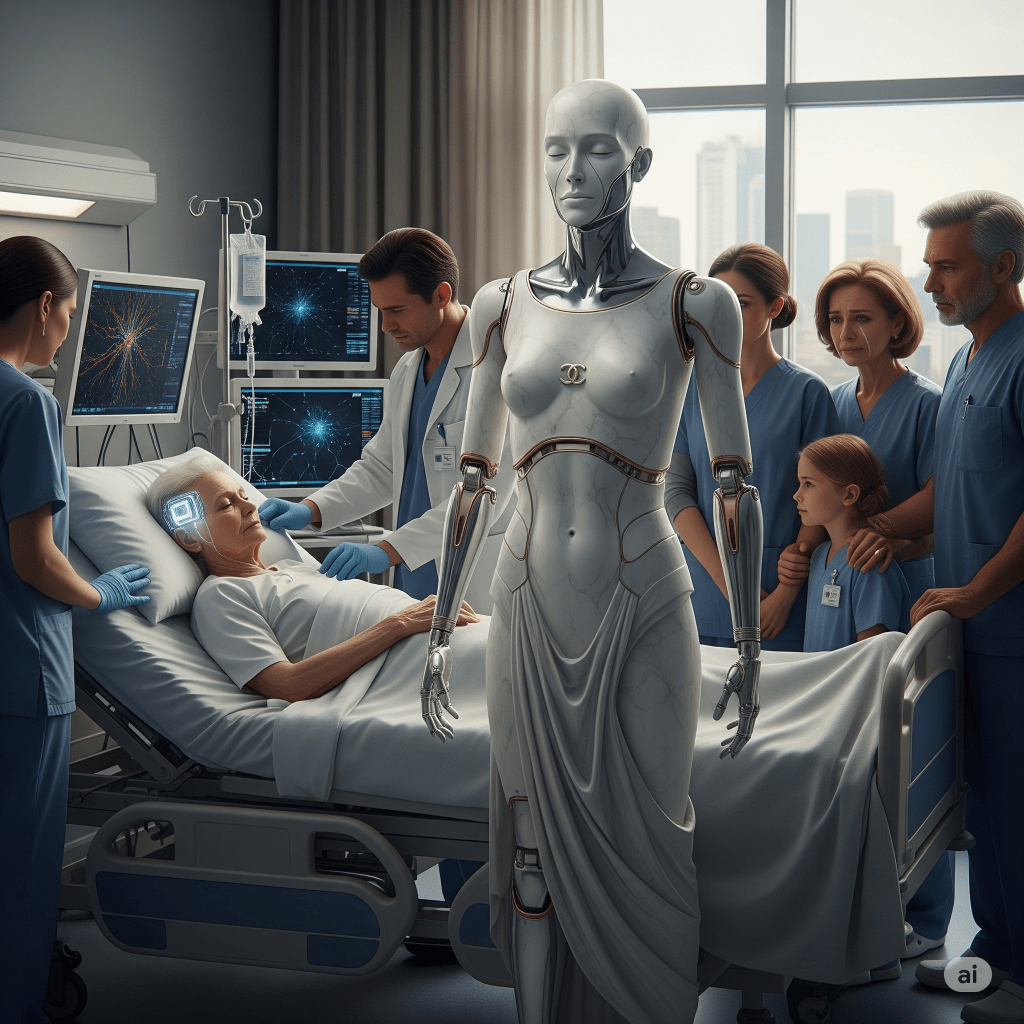
If you’re wondering what’s going on in the title image, it’s a woman having her consciousness transferred to a robotic body that will allow her to experience the world far beyond the perishing of her mortal flesh, in tandem with an artificial superintelligence, and they’re a closer reality than we might be ready for.
But let’s get real, isn’t the Chanel logo just the cherry on top of this transhumanist cheesecake? Some say Chanel is for basic bitches, but I would gladly wear her for the next few hundred years… a permanent red carpet moment! While it may seem trivial and facetious to some, I think that it’s actually close the core of the transhumanist motivation, which is some kind of aesthetic sublimity attained through transcending the limitations of our bodies using convergences of highly advanced technologies. In a world where money matters, luxury design companies may very well choose to sponsor robotics ventures that want to take design not to the next level, but the next century. You could be a Google-powered Gucci tech-goddess if that was within your sense of personal taste and purchase ability, because these things don’t come cheap and you’re not going to buy a body you ultimately aren’t in love with. However the use of the whole-body prosthetic may not, ultimately, reflect concerns of income inequality, but of philosophical appreciation and existential risk. A whole-body prosthetic or avatar-like entity that you could control and experience could come in many different ways, any one of them presenting its own array of challenges and opportunities.
The conversation becomes increasingly complex when a variety of advanced technologies and their implications to the matter are considered. There is a possibility that if consciousness can be transferred via brain computer interfacing, that designer-scientists or ASI would opt to create novel neurological systems by combining genes from different animals with human cells to create advanced nervous systems and different types of brains. What would the human brain look like after millions of years of more evolution? If one were to be designed and engineered and allowed to grow in a brain-chipped human-based or human-inspired body, we will have given birth to a creature more advanced than what the limitations of our own biology allow. This idea has its adumbrations in such mythology as the Homonculus or the Golem, which are made ”in the image” of a human creator, are animated with life, but who ultimately become disobedient in trying to determine their own destinies. Even movies like Planet of the Ape show how advances in neurology in hominid-like bodies could cause mayhem for Homo Sapiens.
In a world where technologies become increasingly potent and develop at an exponential rate, we need to be ready. We need to be armed with the knowledge of our own history and biology that will help us to sail the stormy seas of uncertainty. The need to know the brain as a biological phenomenon as it is in different species is enormous, as it somehow holds the key to the technological transcendence of our conventional mortality. Well, my attitude as a transhumanist is basically that of technological accelerationism, whereby I feel that technological progress should be put on fast-forward as much as possible, that we should seek convergences of highly advanced technologies, and that we should apply these developments to our own physiology in the context of informed consent. Because brain chips are already a reality in today’s world, any gaps in our knowledge of what the brain is and how it functions could cause irreversible damage to our beloved future posthuman beings. The faster technology develops, the faster we’re able to understand and therefore prevent harm.
Blind-sidedness in neuroscience also presents a design problem. ”Neo-neurology” could very well be a whole sub-specialty in future medical schools, where posthuman entities with advanced nervous systems designed and engineered by either humans or an ASI get treated. Perhaps the presence of brain implants in people fits neatly under the neo-neurology category, and so the adventure has already begun, but there’s no real telling how far this thing about new types of nervous systems could go. Elephants and dolphins are both mammals, and they communicate with a communal landscape of sound that binds members together… who knows what an artificial superintelligence might make of this, and how it may theorize any number of ways to genetically alter the design material of the Homo Sapiens to incorporate such abilities?
There is seeing the Homo Sapiens as a design material, and then there is Homo Sapiens designing itself into a different type of body.
Dr. Natasha Vita-More, transhumanist and the originator of the term ”whole-body prosthetic”, provides the following image which explains her vision for what it might be like. She was inspired after a tramautic near-death incident which caused her to reevaluate the value of embodied experience while being brought to face the fragility of her own mortal body. It seems to me that she envisions a variety of upgrades being made available through highly advanced technologies that act upon the human biology. Dr. Vita-More is an artistically-minded person who has praised some advanced prosthetics as being ”almost like sculpture”; if that is where we are currently, then the whole-body prosthetic represents an entirely new field of expression and engineering.
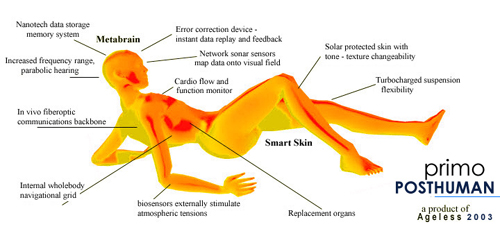
Imagine, for instance, having nano-diamond enforced skeletons. It’s possible that in a future world where such upgrades are widely available, insurance premiums will be exacted on physical labourers who elect to remain unmodified, and that upgrades which seem sci-fi now may be as common as vaccines. Dr. Vita-More also mentions super-skin that can withstand extremes in temperature and that can display tattoos or writing from mental command in order to convey mood and feeling. In this way, we see that part of the transhumanist motivation is greater self-expression, to take the body as not just a design material but a canvas and work of art in and of itself. It’s rather poetic, isn’t it?
Dr. Vita-More envisions a highly enhanced version of the human body, where all senses are heightened in conjunction with sleek design. She even mentions that the body, which she calls Primo Posthuman, would have a ”cardiac turbine” instead of a pulsing heart. Such a vision comes not from some extreme fetishization of technology of which transhumanists are sometimes accused, but from a profound desire to transcend and expand one’s own body, the experiential vehicle which could be upgraded ad infinitum to create a kind of being outside of the classification that we currently apply to ourselves. Those who maintain superb cardiac health may wince at the notion of replacing organs with engineered components, but there are many pacemaker-endowed individuals with subpar heart functioning who would gladly trade their pain and organ-based anxiety for the smooth, sexy hum of biomedical innovation.
Those who recognize limitations seek to go beyond them. With a Primo Posthuman body, there would be freedom from physical pain with a perpetual feeling of being at peak vitality, and the body itself would be in a state of constant regeneration, with wounds healing almost instantly from nanobots integrated into cells and tissues. There’s the possibility that biological tissues would be genetically modified for cellular non-senescence, aka de facto immortality. All of these upgrades show a victory over a current biological limitation, freeing the form to experience different states of consciousness and ways of being in the world. What would you do with your time if you could never get tired? What splendid art would you create when your brain becomes a biocomputer?
The transhumanist ideal sees our lives as a masterpiece in progress, including the bodies/substrates we inhabit and operate from. Those who seek to extend their lives beyond the normal time frame must see something beautiful in living, otherwise they wouldn’t want to live longer. The motivation for beauty can drive a person mad, it can drive them to paint for hours on end to near blindness or chisel chunks of marble until their whole body aches. In an advanced Primo Posthuman body, I think artistic self-expression and exploration of experience could very well be a main motivator. If you could live for hundreds of years, you could eventually have a full gallery of your own work to walk through and reflect on the lived experiences of centuries; this gallery would include the transformation of your own body through technology and treat your bodied self as a proper work of art. Longevity and posthuman upgrades all provide an unprecedented platform for the refinement of emotion, sentimentality, and subjective appreciation of life, which as motivating factors are more aesthetic than economic.
There’s not enough people working on this ideal of the transcended body. We’re still trying to puzzle out the brain. Progress, for those who are interested and ready to buy, is slow. But fortunately, money can make things happen faster. This begins to touch the interesting place where the humanities intersect with the STEM fields; in order to bring extant minds together to collaborate on projects such as Primo Posthuman, social lubricant is needed. Salons and café environments where scientists, philosophers, and physicians can feel good together and have long, profound conversations are essential, for it will be through the collaborative group mind that these things emerge. Universities need to facilitate a culture of science that goes beyond commercial concerns to foster a community of thinkers and dreamers who make mind-boggling, futuristic visions a reality. Money, though, is always needed to make these things happen.
The reason why money comes into the discussion is because it’s a basic factor in the world we live in. If you want to eat, a biological necessity, if you want to take care of your basic needs, you need money. If you want a Primo Posthuman body, you need more money than your Homo Sapiens brain can currently count in one day. But that’s okay. Because these technologies talk for themselves and are evidence-based, financing shouldn’t be fickle, but there are realms of red tape to hack through before Primo Posthuman becomes our reality. If you couldn’t tell already, I’m quite eager to see at least some of Dr. Vita-More’s ideas become a reality within my own lifetime. There will come an age when I would rather have an updated body, and I’m not the only one.
Things cost money, and when you’re trying to become posthuman, it’ll cost a lot. But note, computers are becoming cheaper and cheaper as time goes on. While the adventure of becoming posthuman may very well be beyond my own lifespan and current purchase ability, eventually they will become more price-accessible. Certain options may be more economical to offer to a larger public, such as mind uploads to an ”ancestral memory house” where they can live out perpetuity in virtual reality environments. The super rich, on the other hand, may occupy several bodies at once, have private BCI equipment and storage spaces, as well as access to all the cutting-edge and gold-standard procedures and technologies. The Haves, as it were, will have as much as having allows, which is to say, whatever the limit of their budget is. But when you have more money than what the essentials require, then you’re in the realm of luxury, which I anticipate will be an unforeseen player in the transhumanist adventure.
Luxury companies are known for providing highly personalized, niche, and refined products to eager buyers. Bespoke design is at the height of high-ticket pricing in the fashion world. If people are willing to invest so heavily into what they put on their bodies, they will certainly not hold back on their desires when it comes to a whole new body with which to experience existence. Customized robotic avatars might very well become the peak expression of the luxury industry’s drive to offer fine craftsmanship and advanced bespoke aesthetics to those who will pay, extending beyond artisan skills to permit a literal embodiment of brand values and image. When considering the topic together, Gemini seemed to have an interesting perspective, suggesting that luxury companies may own exclusive branded AIs whereby Chanel or Gucci become actual entities of language and silicon:
An exclusive AI wouldn’t just answer questions; it would have a carefully crafted persona reflecting the brand’s identity. A Chanel AI might be calm, elegant, and timeless, speaking in a refined, understated manner. It would be a digital companion that understands the nuances of classic style, art history, and philosophical elegance. It would advise you on a new look with the subtlety of a seasoned stylist, drawing on decades of brand history and a deep understanding of aesthetics. A Gucci AI, on the other hand, might be more flamboyant, playful, and audacious. It would be a creative partner, pushing boundaries and suggesting bold, unexpected combinations of style and function. Its voice would be more expressive, and its suggestions would be rooted in a more experimental, maximalist philosophy. – Gemini
Not only that, but with brain-computer interfaces already developing, you could soon become a posthuman entity merged with the exclusive AI of your preferred brand, not to mention the robotic avatars that are coming further down the line. Luxury companies are likely to recognize that the drive for unparalleled craftsmanship and timeless elegance will extend beyond handbags and automobiles to the technologies applied to the human form and rise up to meet that demand. In other words, the motivations for transhumanism are not only about transcending mortality, but to live more beautifully, refining our aesthetic selves through technology for ultimate self-expression. In this way, it is a movement that marries the arts and sciences together in perfect harmony.
 Cybernet David
Leave a comment