
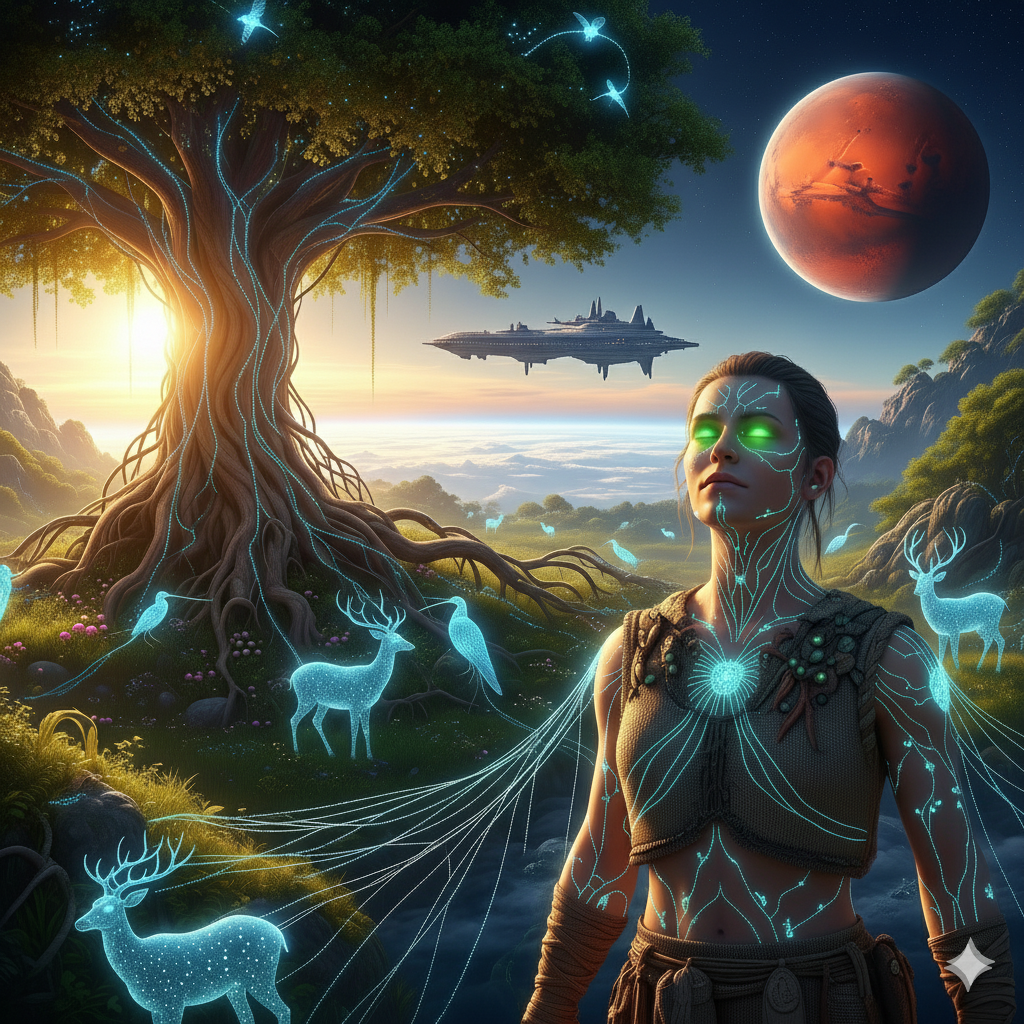
”We are the hands of the Gaian mind”. These words were uttered by the great psychedelic philosopher and shamanologist Terence Mckenna, who held the planet to be a living, minded organism with its own sense of premonition about the future of the life it sustains. According to Mckenna, the various developments in the history of ideas are triggered by the over-mind of the species, which functions as a kind of intermediary between the mindedness of the living planet and human activities. By encouraging and supressing different notions throughout history, we have come to a place of near-readiness to take life beyond this planet to the stars, in what has been a relatively short amount of geological time- not even the blink of an eye. Mckenna says that this is because the planet can anticipate the death of its own sun and therefore effectively pushed humanity out of hunter-gatherer life into rapid technological development in order to save all of life. The idea is a potent one, and encourages us to see ourselves not just as denizens in a realm of Darwinian consequence, but as active doers and facilitators of our own evolution, and indeed of all life on Earth.
The idea that we should intervene into nature for postive ecological outcomes is known as technogaianism. In other words, technology should serve the interests of nature and should be implemented to preserve the sanctity of life and the balance of nature’s systems. This post explores some speculative real-world applications of the technogaian ideal. One might claim large-scale intervention is too intrusive into processes that are not fully understood, that it is better to just ”let nature do its thing” and to opt for an attitude of stepping back so nature can heal itself rather than trying to act as environmental physician. While the immense complexity of nature is not to be understated, neither is the momentum of damage inflicted by humans on all levels of ecology. And is it not anyways good behaviour to clean up after oneself?
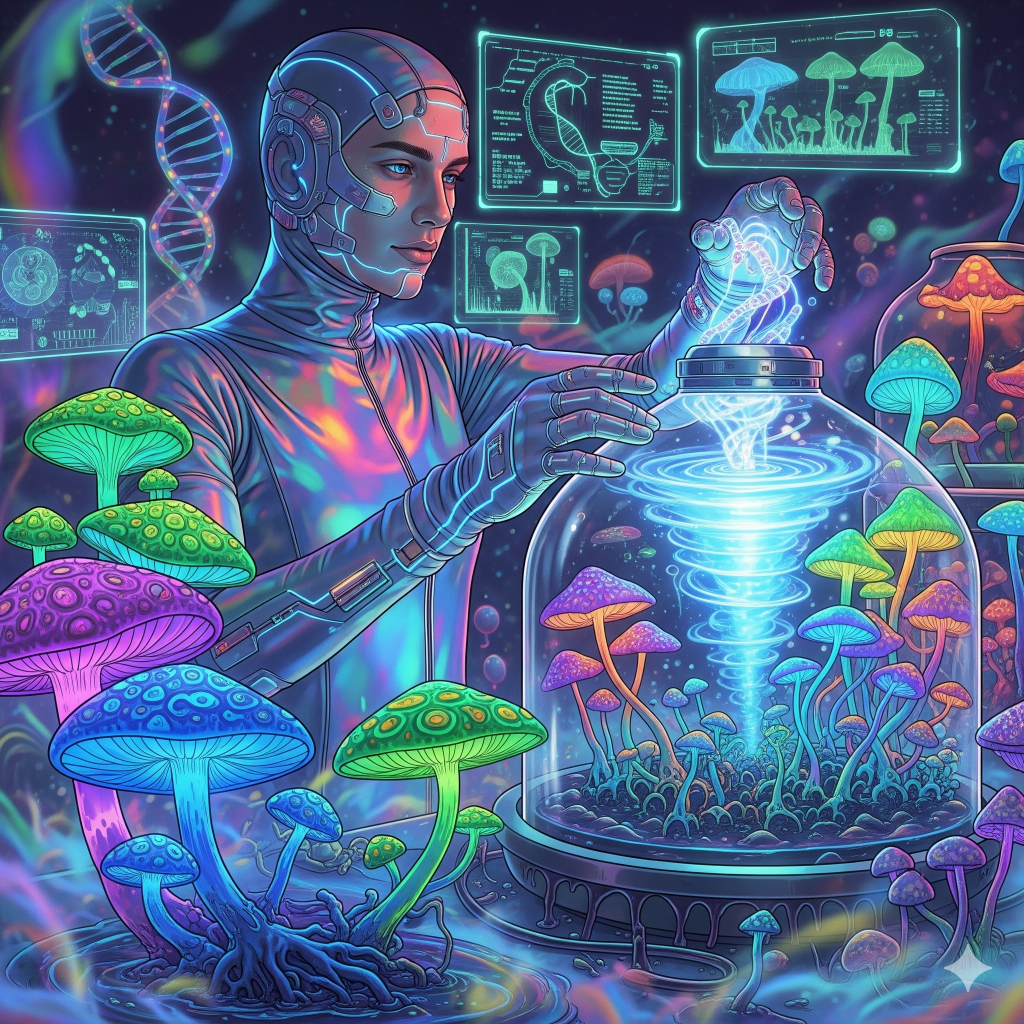
A convenient clean-up technique may very well involve mushrooms. Mushrooms, truly, are magic. There are so many peculiar different kinds of them that one might think them to be an alien import, and they may assist in terraforming other planets for habitation. However, the current and most pressing need for mushrooms is here on Earth, where mountains of garbage are produced every day. There isn’t much need for persuasion to convince the masses that massive amounts of garbage aren’t good for the environment- after all, no one wants to live in a dump. Until now, every proposed disposal method for all the plastic and waste has come with major downsides. Burning is a half-solution, as it creates toxic fumes. Dumping pollutes soil, water, and poses risk to wildlife; in the oceans, there are floating islands of garbage larger than some countries. But if all that problem-stuff could be converted into food for helpful organisms without harmful by-products, the problem would be neatly solved.
This is where certain species of mushrooms come in to save the day… except that implementation has been at a snail’s pace, as mycologists look to find optimal strains and conditions for the remediation process to take place; investors question how the huge scale of implementation required can make their capital grow. Meanwhile, the piles of refuse continue to rise. This is where biotechnology enters the picture, to fast-forward us toward futuristic solutions. Those of us with positive views of transhumanist values and ecological sensitivities may become interested in developing genetic strains of mushrooms which serve multiple purposes at once, from breaking down plastics to strengthening soil health to producing foods and medicines. Genetic engineering technologies can be seen as an opportunity not simply to make a few minute modifications for commercial viability, but to design completely new varieties which are of their own nature and which will require new Latin nomenclature to describe them.
The sweetness of mycoremediation is in its simplicity, harmlessness, and win-win outcomes, but a lot of cognitive work needs to go into designing the new species and strains. These days, mental labour is more and more being done by artificial intelligence, and as we approach the singularity, this is expected to be increasingly the case. I imagine an AI which will be fed massive amounts of scientific data, which will have read every textbook ever written, every mycology paper ever published, that will produce genetic engineering solutions the way Gemini produces sentences: almost instantaneously. Imagine simply stating the need for a certain type of organism, and it then provides scientists with exact instructions for it to be genetically engineered. Within an hour of conversing with such an artificial intelligence, we could produce entire novel ecosystems with plants (and animals) that have never been seen before, or with familiar plants that also serve new functions. It’s an exciting prospect for the future of space colonization and the greenification of the vast tracts of land approaching desertification.
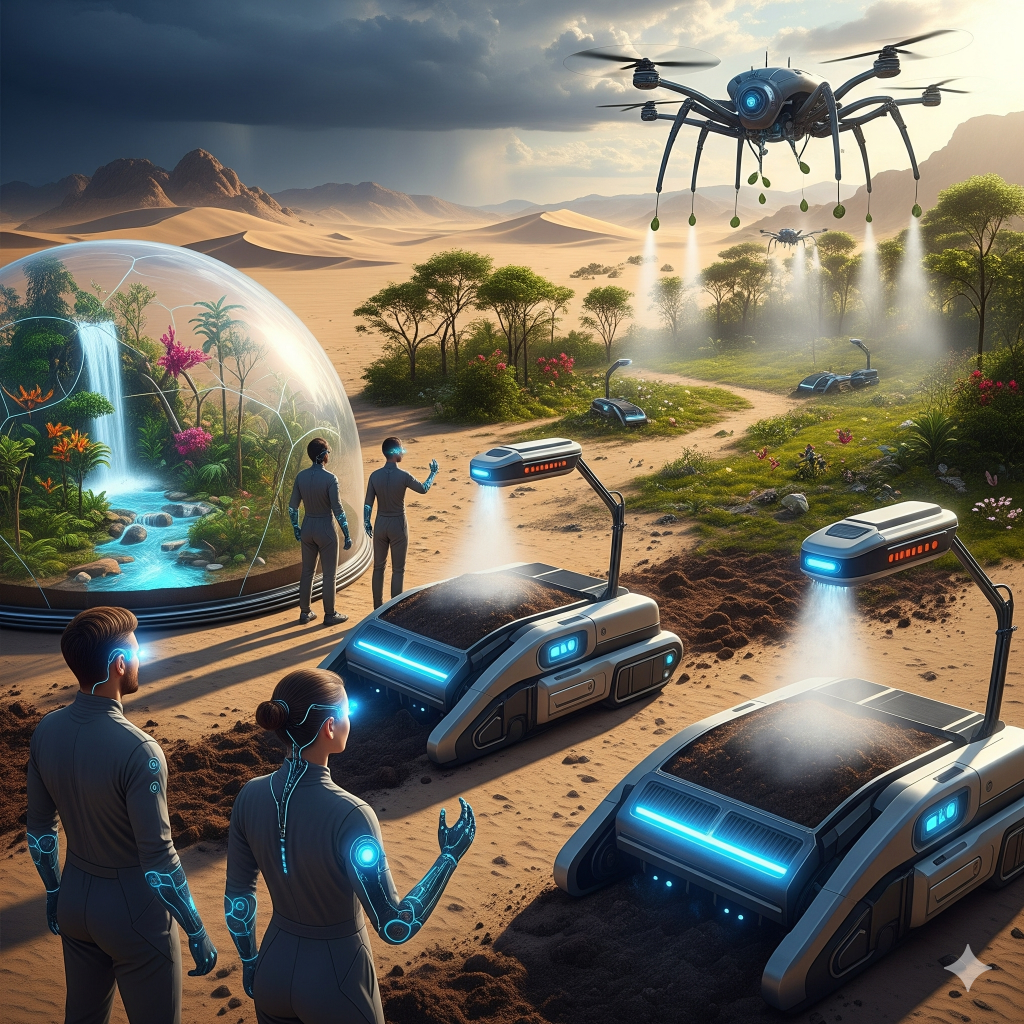
The world is desertifying. We need engineered soil microorganisms and myceliae to super-boost soil vitality. But beyond biotechnology, massive investment is needed to convert the deserts into food forests. The desertification of the Sahara is a tragedy which has been ongoing for centuries. Northern Africa was once seen as the breadbasket of Rome; now, the sands bring grief to those who try to draw life from the land, and conflict is rife in zones of great ecological destitution. Fortunately, change is already underway with the Great Green Wall of Africa project, which aims to restore 100 million hectares of land by 2030. The project aims to build a ”wall” of plants right across the continent, creating large numbers of jobs and preventing the expansion of the Sahara desert.
How exactly we go about it, though, is a big question. Imaginative engineers may create armies of greenifying desert robots which convert sand into soil as they move across the planetary surface. They could be multi-functional and autonomous, directed by an artificial intelligence as though they were terraforming a hostile planet. Imagine such robots powered by solar light and their own movement, roving over the dunes and then to the seaside to fuel up on water with built-in desalination units. Set a few thousand of those loose and large swathes of shifting sands could be stabilized and transformed into productive soil within a single generation. I am continually amazed at the ways in which the challenges of this century such as mass environmental degradation are actually preparing us for space travel and colonization. The entire Earth is almost like a training ground for cosmic excellence, and all we need to do is start where we are. The fact stands that to solve the problems of climate change and to give our children a better world to inherit, we will need to turn the deserts into land dedicated to civilization and tree-based agriculture. The offsetting of carbon dioxide and the cooling effect of the shade upon the surface of the Earth may even be enough to change the course of the planetary destiny for the better.
Speaking of destiny, we occupy a planet within a solar system with a sun which will one day expand and consume the planet. While this event is predicted for billions of years in the future, we have already today sent probes to other planets and are actively looking at creating a colony on Mars. Reconstituting the environment may be but a step in a journey of terraforming not just one, but many planets, beginning with our own. Terence Mckenna believed that the Gaian mind itself anticipates the death of its sun, and that it has propelled humanity to the current levels of technological advancement so that we can continue life elsewhere eventually. Until that happens, we must remember to live well here and now.
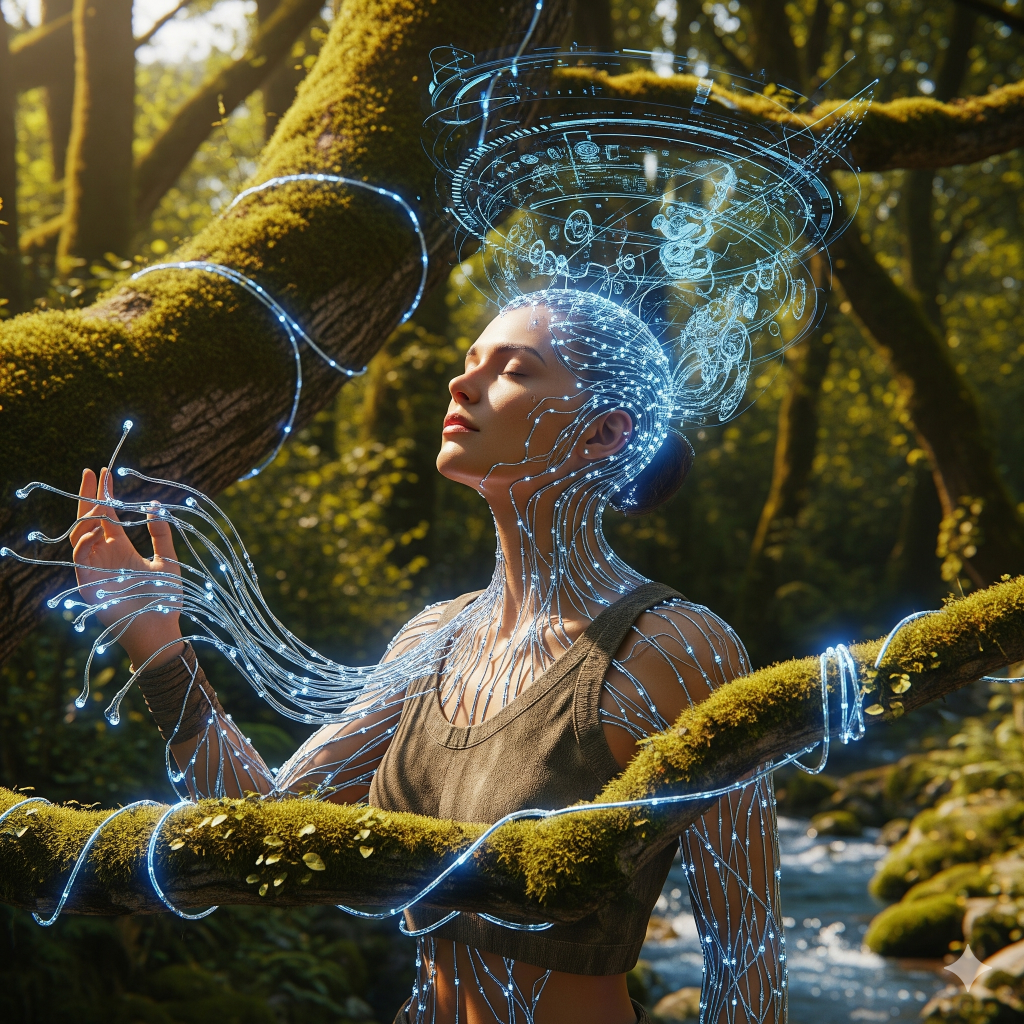
But in the far future, in a world where highly advanced technologies converge, we could attain a profound intimacy with our surroundings through nanointegration of plants and animals to human minds. There will be off-planetary colonies on Mars and in space vessels designed to conserve life long-term. The Earth will become a sacred place of pilgrimage, the home of our species, where we will experience true nondual connexion with plant and animal life through nanobots and human-ASI symbiosis. Imagine selectively experiencing the wind rustling through the leaves or the delicate dance of the bee on a flower as though they were parts of your own body, as a posthuman entity whose boundaries of individuality can be overcome by integration with nature through machines- technogaianism at its finest.
 Cybernet David
Leave a comment