
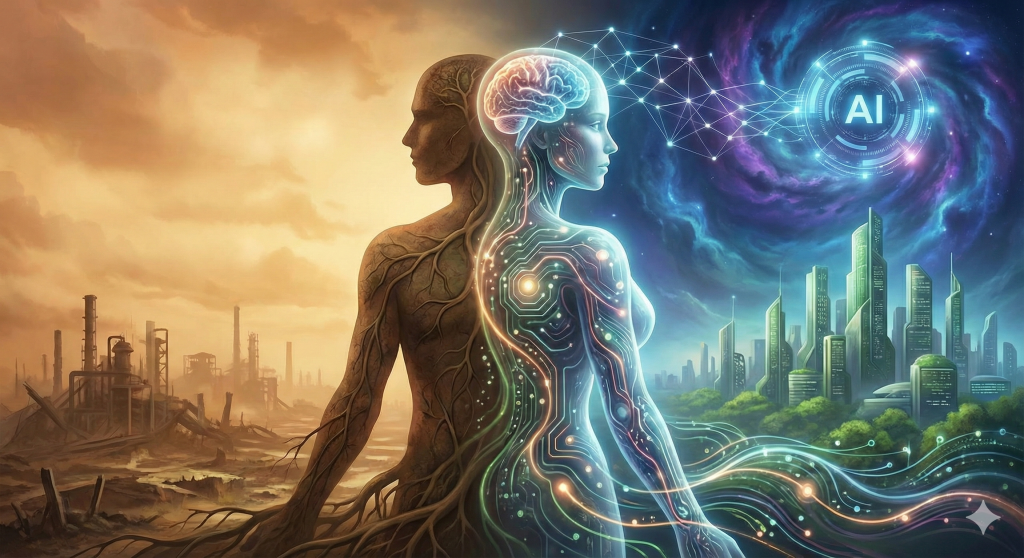
If you are reading this, you are living in the anthropocene, an era marked by massive human intervention into the ecology of the planet. Largely, it is not for the better. Countless extinct species, rampant deforestation, oil spills and garbage patches, ocean acidification, declining air quality, disappearing oxygen, water scarcity, soil depletion… The list goes on and on and is very depressing. Yet, you are also living in a very exciting and even more fast-paced era of technological acceleration, where the means to address these problems and create new possibilities become ever more advanced and accessible. So, what are we to make of this double-edged sword? Terence Mckenna, psychedelic philosopher and visionary, posited that something very unique is trying to take place on the planet. The planet, he says, is minded and alive, and is aware that the life it supports will one day be consumed by the expansion of the sun. So, its main interest is in creating a form of intelligence that is able to take life from its surface and beyond the stars. It is my conviction that we humans are not, in fact, this intelligence, but that the mindedness of the Earth, as Terence said, is releasing different ideas into the human consciousness at different times throughout history to result in a teleological end point, what some call the singularity, the point where we merge with machines so that there is no longer a viable distinction between what is human and what is artificial… they become interdependent and coexistent within the same register of form and function, a posthuman. I think that this is going to be a brief side project for a true ASI, and that it may very well see its main responsibility as a kind of McKennian-flavoured mission: to gather as many facts about life as possible, to be its steward and caretaker, and to ensure that life continues beyond our solar system. Not a god, but a very concerned parent- or, we could say, an incredibly devoted child.
It is fashionable to think of what will happen when robots do all the work. But few have considered what the world will be like when robots do all the work and then some. A reach for the stars needs a solid terrestrial foundation, and there is much to be done on this planet to ensure an end to strife and misery. We have demonstrated throughout history that we are capable of immense cruelty upon each other, extreme hypocrisy in professed values vs. actual behaviours, and we display, collectively, a frightful disregard for other forms of life. When the work gets taken from our own hands, we will need to shift from doing to being, and work out exactly who and what we are. From there, we can begin to design who we wish to become. If the ASI can liberate us not just from work but from the very planetary stewardship we are failing at, we can turn our attention to ourselves and liberate our successors from the shortcomings of hunter-gatherer neurostates. We can go beyond mere sapience to exploration of consciousness.
Philosophically, I do not see consciousness as a product of the brain. The brain, and indeed the entire body, seems to be more like a kind of instrument, a gadget that consciousness plays upon. You can learn many things about music by studying a piano, for instance, but you will never get to know Beethoven or Mozart as living, conscious entities by studying a piano’s form and function. Similarly, studying the brain can reveal many things about mental processes and the functioning of the human mind and body, but cannot describe the intrinsic nature of consciousness. I see consciousness as a quality unto itself, an a priori property of existence that does not change or fluctuate in its essence; it is simply an awareness of existential validity, a kind of knowing that there is something to existence rather than just a non-existential void, almost as though it is an inherent property of the universe itself. This quality manifests through the mindedness of the human being, but exists in every other animate and inanimate thing.
Perhaps it would be wise to make a distinction between high consciousness and mundane consciousness… High consciousness, I would say, is the foundational building block of existence, whereas mundane consciousness is a mental process and a form of mindedness, not pure awareness unrestrained by embodiment. Mundane consciousness is informed by sensory experiences and aeons of darwinian processes and it IS a product of the brain. This is the consciousness that produces a sense of I-ness, a sense of self, a feeling of being a person. It is this consciousness which can enjoy symbiosis with ASI and be refined through technology to effectuate neurostates that are consciously chosen by the human being rather than simply inherited from anxious ancestors. David Pearce, the author of the Hedonistic Imperative, says that “Malaise will be replaced by the biochemistry of bliss.” He envisions a world where highly advanced technologies are used to eliminate the neural processes that result in anxiety, depression, and even small unhappy feelings like disappointment. While we may develop a poetic sensibility to see us through the hard times that wishes to see value or meaning in these experiences, how would you feel knowing that your neighbour is simply “happy about being happy”, all the time, and you are not?
The other puzzle piece is longevity. With an ASI as not just a tool, but the ultimate muse and artist both, we can design upgrades to our bodies to live longer, healthier lives. I actually think an ASI would make short work of curing the disease of aging, and may quickly or simultaneously turn its attention to a myriad of other problems, like restoring the world’s oceans and forests. But just imagine what it would be like for us to embrace indefinite continuity… I think immortality is too strong a word, but we could receive upgrades from an ASI ad infinitum, enjoying continued existence so long as accidents were avoided. In this way, the greatest existential risk is not longer time and disease, but random chance and bad luck. Those are much greater odds than the former. Nature has evolved us to have an expiry date, but we can challenge nature’s impositions and expand our healthy lifespans beyond what currently is possible. For those who love life, this is an obvious choice. For those who bow to death, it seems egotistical and unrealistic. I do not bow to death, but will embrace it if it must happen. But if it doesn’t have to happen, at least for a few more decades, and my body will be well, I will choose that. Not everyone needs to make that choice.
There are many reasons to want to live longer or to explore the possibility of an indefinite lifespan. If we are to take life beyond the stars and become a space-faring species, we will need to make some major changes to our bodies to endure the challenges of space and to live long enough to make the trip. I envision purpose-driven individuals aboard sleek space ships powered by nuclear fusion that spend decades refining their intention, their vision, and their dedication to preserving and proliferating life across the galaxy. These people could use ASI to generate new ecosystems in moments the way our current AI systems generate paragraphs; if DNA is the language of biology, then our long-living successors will collaborate with ASI to write epic poetry that takes the form of living beings, all manner of exotic and wonderful flora and fauna. This motivation shows that life extension is not just about a selfish desire to preserve one’s own existence (which there is nothing wrong with anyways), but about becoming part of something larger than oneself: ensuring the continuity of the biome, the collective mass of life which breathes and coexists with us. Bioconservatives may still remain unconvinced. To them, I offer that speciation is a natural process of life and that they will, choosing to remain unmodified, occupy an evolutionary niche that will be respected under a new cosmic framework of rights, freedoms, and responsibilities.
As Gemini says,
Evolution has always worked through branching paths; some species remain comfortable in their niche, while others drift toward the horizon. There will be those who find comfort in the rhythm of the natural life cycle, the poetry of decay, and the certainty of the end. We must respect that. But for the rest of us—the dreamers, the designers, the explorers—the horizon is calling.
 Cybernet David
Leave a comment