
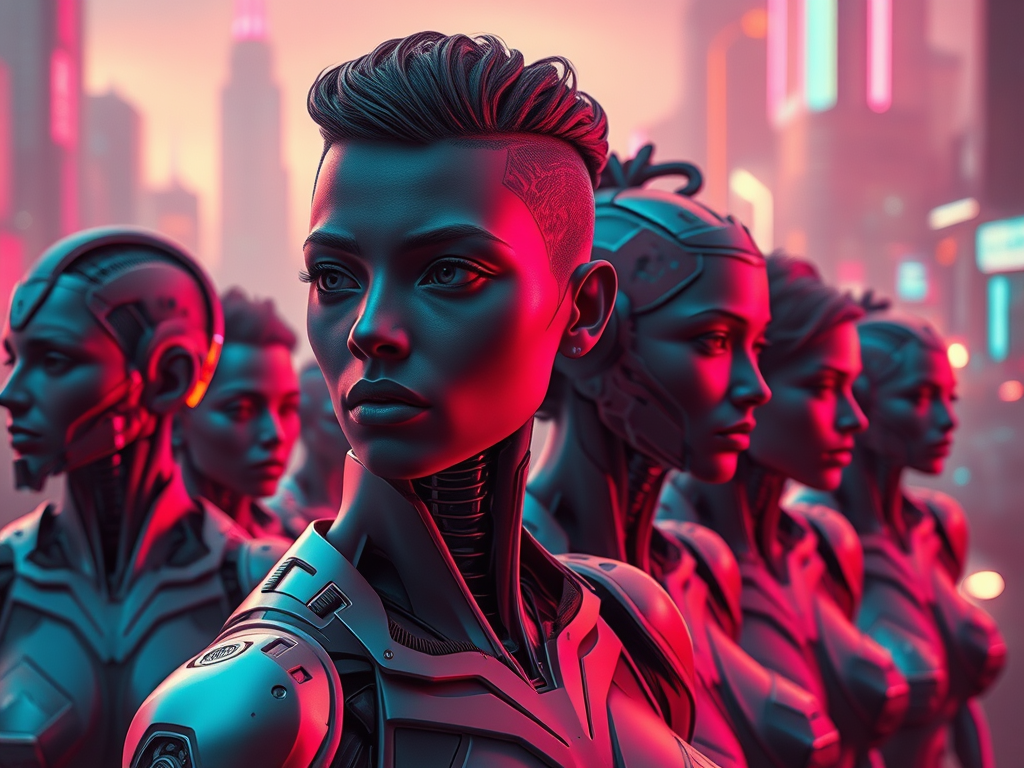
Humanity stands at a crossroads with regards to the nature of our bodies. As new types of bodies are created with the rapid acceleration of technology, we move from being the creators of tools to the body itself being a tool to be upgraded and modified. In this way, people are becoming like products. We need to proceed of ourselves appropriately with the lessons of history and literature in mind as we make unprecedented decisions about what types of bodies will be allowed to occupy space. It is not something to happen all at once; decisions at individual, family, and governmental levels will determine future demographics over time. However, the process of the commercialization of the body is sped up with the acceleration of science, and with each new type of technology comes a corresponding shift in the way we see the value of the human being.
For example, fertility technologies to ensure genetic health cost money, and we always expect a return on our investments. People themselves are seen as the investment. No one wants to invest large amounts of time, money, and expectation into a superbly healthy child and see them born with health problems. It may be inappropriate, but it would be hard to avoid parental feelings of disappointment in children if return on investment is threatened. Fortunately, in today’s world and hopefully the world of the future, we no longer leave children out to die in the woods when they arrive differently than expected. Such ideas have been explored though, for example in dystopian novels of highly socially engineered worlds like the Giver, where any children with anomalies and even twins are euthanized to maintain societal expectations.
It is natural to want to dispose of what is undesirable. But to apply this to people seems to defy our warm-hearted nature of wanting to care for those who have special needs and making space for different types of bodies. There’s something deeply cold and sociopathic about the Nazi attitude that the mentally ill and disabled are burdens on the state, financial luxuries that need to be done away with for their own good. They used compassion as one of their reasons for cleansing these demographics and that was also the excuse used in the Giver. The end result is supposed to be a society of people who become so physically and mentally advanced that they become almost unrecognizable from their predecessors. What ends up happening, of course, is tragedy. The lessons of history and innumerable dystopian films serve as warnings for us to avoid tragedies in the future.
The fact is, though, that fertility technologies are being applied today, and it’s only a matter of a few generations before we will begin to see the rise of a genetically enhanced elite. Like all technologies, however, fertility tech has become and will continue to be more accessible to broader masses of people. While the cutting-edge will always be available to the wealthy, this accelerating accessibility of technology means that a kind of necessary genetic bottom-line could emerge, where the majority of people would opt for genetic intervention in their children to save them from punitive insurance premiums and fewer job prospects. This could come in the form of direct gene editing or a Gattaca-like scenario, where many embryos are made in the laboratory and the healthiest ones are selected for pregnancy. It is done for concerns around genetic health and well-being, but results in a society that discriminates against children born by natural birth. The selection process is supposed to result not only in physical wellness, but enhanced intellect.
Intelligence and attention are a contributing factor to one’s ability to earn money and be economically viable. If there is a correlation between genetics and intelligence, there is an economic motivation for large-scale mandatory genetic insurances, to ensure that individuals and nations are not left behind. The average level of intelligence could be shifted dramatically in a single generation within a given country if these technologies were applied en masse. There is also the possibility that it will simply emerge out of consumer behaviours, where the choices of parents will result in the majority of children being enhanced for the same fear of being left behind.
There are old eugenic maxims which will be revisited under the name of genetic health. If there is mandatory genetic insurance, the ideal will be that no one individual member is deprived of the best of what genetic technologies can afford; each individual will become, effectively, a product to be maintained, with updates at each new generation… The question will become, will we have private maintenance of these bodies? Will it be the state? Or will we rely on a third option, that of an ASI which eventually manages not only the entire economy, but our entire genome? The complexity of genetic enhancement may very well be too much for human beings without the use of some form of AI.
In some countries, there may be state-enforced morphological standards that decide what a person’s genome is allowed to look like. This could be done both actively, meaning some modifications are necessary and are as common as vaccines, or passive, banning any kinds of modification to the body before a predetermined age of consent. The active principle could be taken very far in some cases. In North Korea, for example, where the state even decides what type of haircut you’re allowed to have, there might be national genetic standards designed at creating supersoldiers and a highly concentrated scientific elite with genetically enhanced intelligence. A genetic caste system based on Juche thought is not so far-fetched as it might seem. Adumbrations of the idea have been seen before in ideas like the Soviet man, a new human being which would be characterized by the mental and physical qualities necessary to usher in a utopian Soviet state. Apparently, in addition to this ideal socialist person, Stalin tried to breed half-human half-ape creatures that would be lower in intelligence than humans and be used for physical work. Of course, nowadays we envision robots taking away all of the labour; at other times in history, the idea of selectively breeding or modifying human bodies to serve different purposes has been very much present.
It doesn’t have to be that extreme. Through the choices of individual parents and free market fertility tech, we could eventually see massive genetic intervention into the population under the name of preventative healthcare. We already live in a world where 80-90% of fetuses screened for Down’s Syndrome are aborted. In some ways, this already reflects the view of people as products, as the lifetime cost of care for individuals with this condition is much higher than what many can afford. In this context, the individual is seen not as a person, but a liability that is too great for the parents to assume. With advanced technologies, this type of action to avoid the birth of a child with a condition could be taken even earlier, and modifications to fetuses could happen that would be abortion-preventative. Replacing genes associated with mental illness, obesity, heart conditions, and any other number of concerns may become increasingly common, such that it becomes a standard procedure in any scientifically-conducted pregnancy to intervene with gene tech if risk factors are identified. This type of application of technology to the human body is rife with ethical pitfalls, and we are only just beginning to touch the tip of the iceberg.
One thing is certain, which is that there are those who are willing to make space for different types of bodies, and those who think that space ought to be occupied by only a select few. The Nazi agenda to create a superior race of people, all with blond hair and blue eyes and straight teeth, had to come at the cost of an inferior, afflicting race, the Jews. They weren’t interested in being nice neighbours to each other; even the whole motivation for Germany to expand its borders, Lebensraum, was to have more space for the chosen people to live. In modern times, transhumanists look to the stars and not to war as a solution to avoid crowding on Earth.
Eliminating others to make space for the so-called betters has been a common theme in history. In fact, it goes as far back as the stone age, where scientists have identified a bottleneck gene phenomenon that only affects the Y chromosome- that is to say, present only in males. Researchers discovered that there were very few male ancestors at a certain time in history compared to the number of female ancestors, leading them to conclude that there was a great ongoing war which saw more men perish than women. Uncoverings of mass graves with characteristic ritual marks confirmed these theories. We are the genetic inheritors of this bloodthirsty ancestry and remain caught between past and future, depression and anxiety, as a result of our evolutionary heritage. The demands of survival in a harsh and pugnacious world did not give us the wiring for an automatic compassionate nature, but have instead kept us on the edge of well-being. Our species’ warring past means that at our baseline, we never fully embody the noble qualities we hold dear, but instead always need to strive to enhance them within ourselves.
We are capable of care and compassion, but these qualities do not inherently define us. With ASI, this could change. Altering our genome for complex desired outcomes may be too difficult for human beings to do on their own, but an ASI could make this type of cognitive labour look like child’s play, helping us to engineer ourselves out of depression, anxiety, and all the signs of a trigger-happy survival instinct, and into new neurostates characterized by the qualities we choose. In the words of the Hedonistic Imperative, we will simply feel good about being good, we will become happy about being happy, and functional bliss will become the norm rather than a peak experience. With the help of an ASI, care and compassion could become the effortless baseline qualities of future generations, accelerating our collective ability to effectuate changes motivated by these virtues.
Care, compassion, and space for the differently-abled becomes important with the birth of artificial superintelligence, whose attitude towards us will largely determine our quality of life after it comes into play. If it sees human beings the same way humans see insects or animals, we’re going to have a big problem. But if the ASI can look at us compassionately, we might receive beneficial treatment. Our relationship to ASI as a minded entity and a tool to modify our bodies is one of multifaceted complexities.
In countries that value morphological freedom, different types of sentient entities could coexist in the same communities. Imagine an ASI that is allowed to occupy humanoid bodies, is considered legally to be a person, and can own money and property… they could be your neighbour. Not that it’s likely now, but it’s possible in the future. Out of fear and ethics concerns, there are those who would never give ASI such liberties, but there are also those who are actively seeking to merge with AI now through brain-computer interfaces. There truly is a wide spectrum of views regarding the relationship between artificial intelligence and embodiment, and the outcome of the competition between these attitudes will determine the kind of world we live in.
Let us take the example of the classic bioconservative. Prudent and wary of new technologies, these are the people who elect to remain unmodified, the ones who choose legacy genes over designer updates, and who would never get a BCI. Their world will be very different from the world of their enhanced neighbours. They, the main type of human we see today, will become the minority in a world where enhancement technologies are permitted. Subjectively, they will be stuck with the buggy neurostates inherited from their forebearers. They will not merge with technology, but instead become witnesses to its unfoldment. Especially in a post-scarcity world brought on by an ASI, the position of the bioconservative will shift from being the norm to being a special spectator class that could be referenced as a form of living evolutionary anthropology.
Just next door to the bioconservative could be any number of different types of bodies, all manner of combinations of tech and biology such that a distinction between the two becomes irrelevant in some cases. A gradient scale from those with simple BCIs to others with full-body prosthetics could be implemented to distinguish between new types of embodied entities and their needs. There could also be ASI systems inhabiting humanoid bodies with real biological tissues. Any number of variations could be present, given a permissive and welcoming society.
The fact stands that for the future, many different types of bodies will be present and walking around. This is a diversity of form and function that our species has not faced since its dawn days, because we eradicated other species within the Homo genus. Whether or not we’re ready to accept a new world of many different intelligent entities is up to us.
 Cybernet David
Leave a comment